> ## Documentation Index
> Fetch the complete documentation index at: https://docs.solo.one/llms.txt
> Use this file to discover all available pages before exploring further.
# Network Roles
> The three ways an entity can participate in a network
Every entity that participates in a [network](/concepts/governance/networks) does
so in one or more **roles**. The role determines what the entity is allowed to do
on that network — administer it, supply data to it, or query data from it.
## The three roles
Administers the network. Governors manage settings, add and remove participants, and configure how data is allowed to flow between this network and others.
Supplies data into the network. Furnishers write records that other participants can later query, subject to the network's governance rules.
Reads data from the network. Queriers retrieve records that have been furnished by other participants in the network.
## What each role is responsible for
### Governor
The governor is the network's administrator and the accountable party for its
configuration. In practice a governor:
* **Manages the participant roster** — adds entities to the network with the
roles they need, and removes them when an arrangement ends.
* **Owns the policy surface** — creates and configures the
[querying policies](/concepts/governance/querying-policies) and
[furnishing policies](/concepts/governance/furnishing-policies) that govern
each product in the network.
* **Sets governance rules** — decides whether related networks may query this
one (see [Network Governance](/concepts/governance/network-governance)).
* **Introduces subnetworks** — subnetwork definitions furnished through bulk
ingestion are accepted only when the caller governs the target network.
A governor seat is **not** a window into other members' data. Reading data
still requires the querier role plus [consent](/concepts/identity/consent) and
[entitlement](/concepts/governance/entitlement), like any other participant.
### Furnisher
The furnisher contributes data. A furnisher:
* **Furnishes product records** — calls `POST /v1/products/{product}/furnish`
(or bulk paths like [SFTP](/api-overview/sftp/overview) and
[file upload](/api-overview/furnishing/file-upload)) naming the network,
subnetwork, and application date.
* **Earns entitlement by contributing** — each entity a furnisher contributes
data about becomes an entity whose consolidated data the furnisher may read
back on future queries. See [Entitlement](/concepts/governance/entitlement).
A furnisher does not need to know which furnishing policy applies — the network
resolves it automatically from the subnetwork and application date.
### Querier
The querier consumes data. A querier:
* **Creates consent records** — querying a consumer or business requires a
valid [consent](/concepts/identity/consent), so the consent endpoints are part
of the querier's day-to-day surface.
* **Runs product queries** — calls `POST /v1/products/{product}/query` scoped
to the networks it participates in (or networks reachable through
[governance rules](/concepts/governance/network-governance)).
* **Searches entities** — looks up consumers and businesses within the
network before querying.
What a query returns is never determined by the role alone: the
[querying policy](/concepts/governance/querying-policies) caps what the product
may expose in that network, and [entitlement](/concepts/governance/entitlement)
narrows it to what the caller has earned.
## Role-to-endpoint capability matrix
The table below maps the public `/v1` API surface to the role that exercises
it. ✓ marks the role an operation belongs to; — means the operation is not
part of that role's job.
| Endpoint | Governor | Furnisher | Querier |
| ---------------------------------------------------------------- | :------: | :-------: | :-----: |
| `POST /v1/consent/consumer` | — | — | ✓ |
| `GET /v1/consent/consumer/{consent_id}` | — | — | ✓ |
| `PUT /v1/consent/consumer/{consent_id}` | — | — | ✓ |
| `POST /v1/consent/business` | — | — | ✓ |
| `GET /v1/entities/consumer/search` | ✓ | ✓ | ✓ |
| `GET /v1/entities/business/search` | ✓ | ✓ | ✓ |
| `POST /v1/products/{product}/query` | — | — | ✓ |
| `POST /v1/products/check` (coverage check) | — | — | ✓ |
| `POST /v1/products/{product}/furnish` | — | ✓ | — |
| `POST /v1/file-upload/ingest` (data workbooks) | — | ✓ | — |
| `POST /v1/file-upload/ingest` (subnetwork / policy workbooks) | ✓ | — | — |
| `POST /v1/networks/policies/querying` | ✓ | — | — |
| `PUT /v1/networks/policies/querying/{policy_id}/configuration` | ✓ | — | — |
| `POST /v1/networks/policies/furnishing` | ✓ | — | — |
| `PUT /v1/networks/policies/furnishing/{policy_id}/configuration` | ✓ | — | — |
| `GET /v1/networks/policies/furnishing` | ✓ | ✓ | ✓ |
| `GET /v1/networks/policies/furnishing/{policy_id}` | ✓ | ✓ | ✓ |
| `POST /v1/institution-attestation` | ✓ | ✓ | ✓ |
**How to read this matrix.** It describes the *operational model* — which role
each operation belongs to in a well-run network. Enforcement happens at
different layers depending on the operation. Network administration (managing
memberships, accepting subnetwork and policy definitions) is hard-enforced
against the network's governor. Reads are enforced through network scoping,
[consent](/concepts/identity/consent), and
[entitlement](/concepts/governance/entitlement) — so calling a query endpoint
without the underlying permissions yields an authorization error or an empty
result rather than data. Don't treat a missing per-endpoint role check as a
grant of access; SOLO may tighten per-endpoint enforcement over time.
Rows marked for all three roles are member-level operations: any participant
can search the directory of entities within its network scope, read the
furnishing policies visible in a network it belongs to, or attest for its own
institution.
## What each role gates
Each role gates a specific kind of action on the network, and the three gates
are independent of one another:
| Role | Gates |
| ------------- | ------------------------------------------------------------------------------------------------------------------------------------------- |
| **Governor** | Editing the network's settings, adding and removing participants, configuring governance rules, authoring policies, introducing subnetworks |
| **Furnisher** | Writing data into the network |
| **Querier** | Reading data from the network |
The gates do not overlap. An entity holding only the furnisher role can write
data but cannot read it back out — reading requires the querier role on the
same network (or, via
[Network Governance](/concepts/governance/network-governance), on a related
one). The same is true in reverse: a querier cannot furnish data.
This is why most operators who both supply and consume data on a network hold
both the furnisher and querier roles.
## Roles are additive
An entity can hold more than one role on the same network. A bank that operates
a network it also furnishes into and queries from will typically hold all three
roles. SOLO records each role as a separate participation, so revoking one role
does not affect the others.
The same entity cannot be granted the same role twice on the same network —
each combination of network, entity, and role is unique.
## Roles are network-specific
Roles do not transfer between networks. An entity that is a governor of one
network has no automatic role on its parent, child, or cousin networks. To
participate elsewhere, the entity must be added explicitly to each network it
operates on.
What *does* transfer is **query access** — a querier on one network may,
depending on governance rules, be allowed to query data scoped to a related
network. See [Network Governance](/concepts/governance/network-governance) for
the full rules.
## Who can change roles
Only a governor of a network can add or remove participants on that network. A
governor of a parent network cannot directly add or remove roles on a child
network — they would need to be a governor of the child as well.
Two safety rules apply, and both are enforced server-side:
* **A network must always have at least one governor.** SOLO rejects any
change — demotion, reassignment, or removal — that would leave a network with
zero governors.
* **An entity can always remove its own participation** in a network (as long
as doing so wouldn't violate the rule above).
Attempts that violate these rules fail with an authorization error in the
standard envelope (see [Errors](/home/errors)):
```json theme={null}
{
"detail": "Permission denied",
"error_code": "PERMISSION_DENIED"
}
```
## What's next
* See [Network Governance](/concepts/governance/network-governance) for how
participation translates into query access across the network tree.
* See [Entitlement](/concepts/governance/entitlement) for why holding a role is
necessary but not sufficient to read data.
## In the dashboard
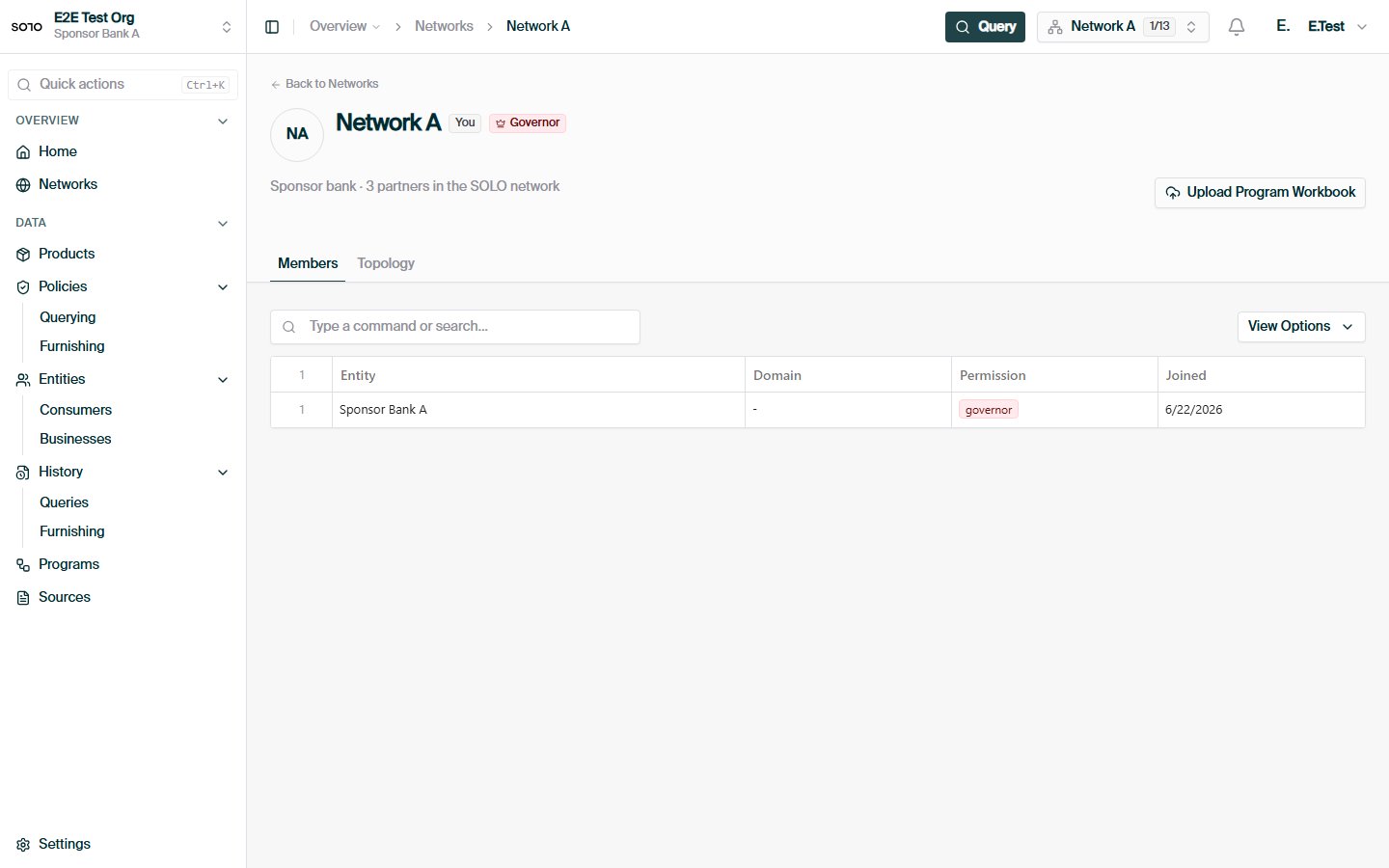 ***
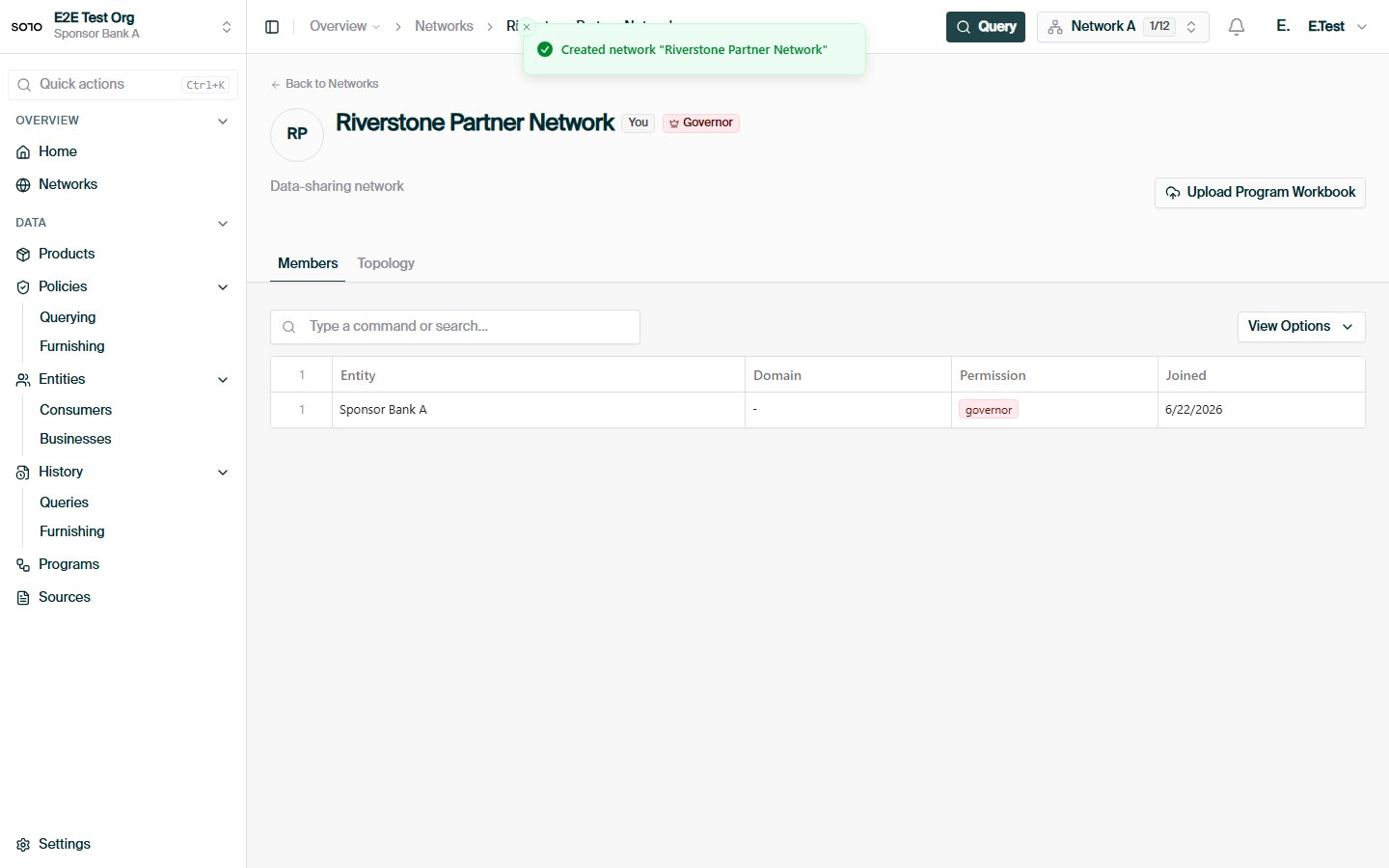
**A note on governors.** SOLO currently distinguishes between a network's *governor entity* (a single entity recorded on the network itself, set when the network is created) and entities holding the *governor role* (which can be more than one). In practice these are kept in sync — the entity that creates a network is recorded as the governor entity and is also granted the governor role automatically. Today, only the entity recorded as the governor entity can edit the network's settings, even if other entities hold the governor role. This distinction is under review and may be removed in a future release; we will update this page when the decision is final.
***
**A note on governors.** SOLO currently distinguishes between a network's *governor entity* (a single entity recorded on the network itself, set when the network is created) and entities holding the *governor role* (which can be more than one). In practice these are kept in sync — the entity that creates a network is recorded as the governor entity and is also granted the governor role automatically. Today, only the entity recorded as the governor entity can edit the network's settings, even if other entities hold the governor role. This distinction is under review and may be removed in a future release; we will update this page when the decision is final.